
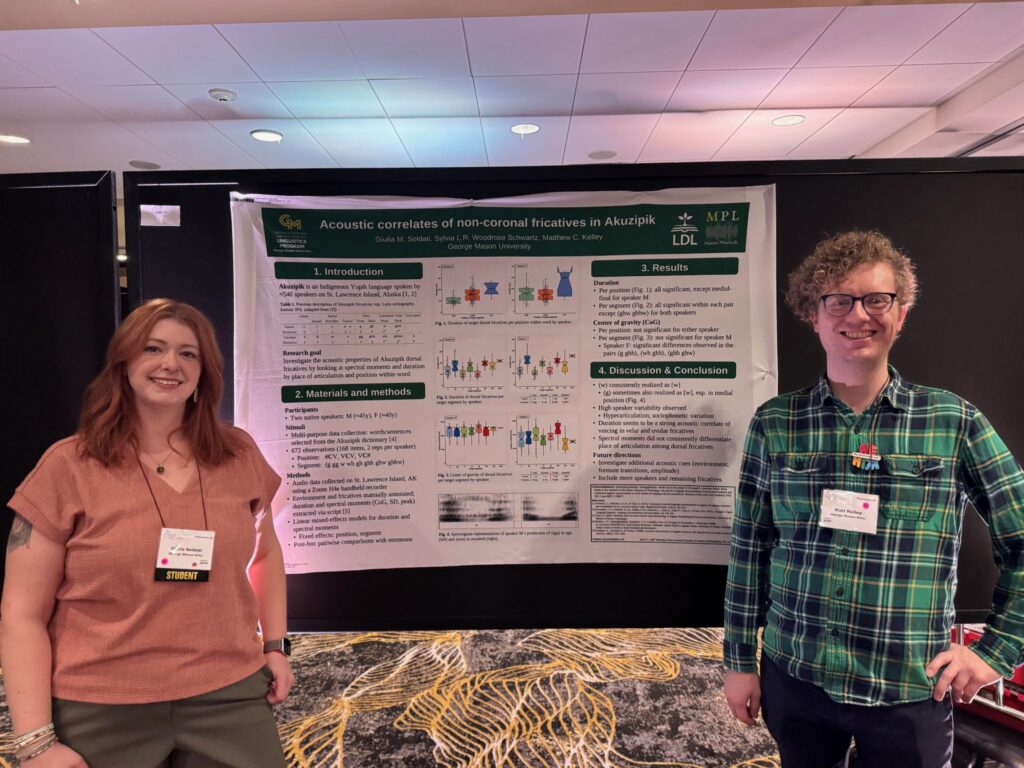
This week, one of our lab affiliates, Giulia M. Soldati, traveled to Philadelphia, Pennsylvania to present a portion of her work on the St. Lawrence Island Akuzipik sound system at the 190th meeting of the Acoustical Society of America (ASA). Giulia’s presentation focused on investigating acoustic properties of some fricatives in Akuzipik through spectral analysis and statistical modeling.
Her investigation involved a wealth of audio recordings of native Akuzipik speakers gathered during a fieldwork excursion in the summer of 2025. These recordings were then meticulously catalogued, coded, and analyzed to gain a better picture of Akuzipik dorsal fricative behavior. Broadly, she found that Akuzipik speakers tend to produce longer voiceless fricatives than voiced fricatives at the same place of articulation, and that the position of the fricative within the word also appears to have an effect on its length. Additionally, she confirmed a previously anecdotal observation that speakers tend to produce the sound represented in Akuzipik orthography as <w>, namely [ɣʷ] or oftentimes just [w], in places where one would expect [ɣ] (represented by <g> in the orthography). For example, the word *yuget* is often realized as [juwət]/[juɣʷət] instead of [juɣət].
Giulia presented her work, conducted in collaboration with our lab director Dr. Sylvia Woodrose Schwartz, and GMU Ling faculty Dr. Matthew C. Kelley, at the ASA’s poster session. Her doctoral research expands on this work and investigates other aspects of the Akuzipik sound system in order to facilitate thorough documentation of this language and to expand our knowledge of the breadth of human language and speech sounds.